
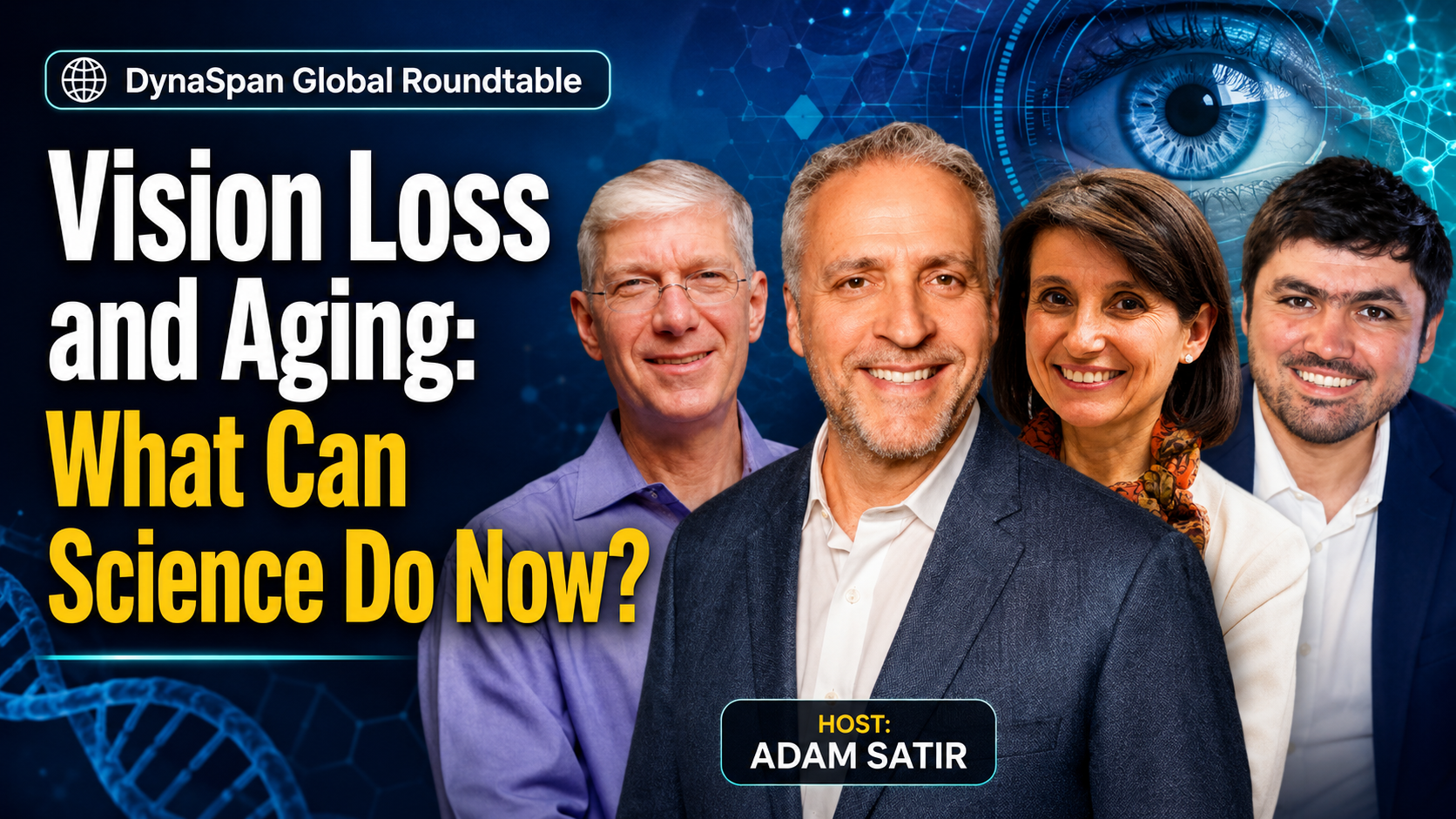
DynaSpan Global’s inaugural roundtable brought together three experts from very different corners of healthy aging — a molecular biologist, a pharmaceutical veteran, and a tech entrepreneur — to talk about a topic most people don’t connect to aging until it happens to them: vision loss. Hosted by Adam Satir, the conversation moved from the cellular biology of aging to the decade-long slog of drug development to the AI tools already changing both.
Meet the Panelists
Dr. Anna María Cuervo is a distinguished professor at the Albert Einstein College of Medicine and one of the world’s leading researchers on the biology of aging. Her lab studies autophagy — the process by which cells clean out their own waste — as one of the key drivers of how we age.
Dr. Jim Bryson is a biochemist and longtime pharmaceutical executive, with a career at Bristol Myers Squibb spent bringing new biotherapeutics from early discovery through the first human clinical trials. He brought the industry’s-eye view: what it actually takes, and how long it actually takes, to get a new medicine to patients.
Renée Espinoza is the founder and CEO of MapVX, whose navigation app Lazarillo helps roughly 600,000 people with vision loss and blindness move through cities independently, using real-time audio feedback. She also works with governments and private companies to map and improve the accessibility of physical spaces.
Aging Isn’t One Disease — It’s the Root of Many
The conversation opened with macular degeneration, one of the most common causes of vision loss in older adults, but quickly zoomed out. Dr. Cuervo explained that the field of aging biology isn’t trying to eliminate aging — it’s trying to compress the gap between how long we live and how long we stay healthy. That idea sits at the core of a relatively young discipline called geroscience, built on the observation that age is the single biggest shared risk factor across diseases as different as Alzheimer’s, cancer, diabetes, and macular degeneration.
Researchers have identified roughly 14 “hallmarks of aging” that interact differently across individuals and organs. Autophagy is one; a second, raised by Dr. Bryson, is immune dysfunction — specifically the way a normal, protective inflammatory response can become chronic and start doing damage on its own, contributing to conditions like macular degeneration and glaucoma. As Dr. Cuervo put it, organs don’t age in isolation — they cross-talk, so what researchers learn in the eye or brain often applies elsewhere.
The Human Side: Losing Independence
For Renée Espinoza, the clinical picture connects directly to daily life. She described how the hardest adjustment for people with vision loss usually isn’t the vision itself, but the loss of independence — something as simple as knowing when to get off a bus. That gap is what led her to build Lazarillo, which narrates a user’s surroundings and transit stops in real time. She also pointed to a broader accessibility problem: many mainstream apps still aren’t built for screen readers, leaving basic functions unusable for blind users even as technology races ahead elsewhere.
Why New Treatments Take So Long
Dr. Bryson walked through what “translational medicine” actually means in practice — the long, structured path from a discovery in a lab dish, to mouse studies, to three phases of human clinical trials, to a drug on a pharmacy shelf. He used his own experience bringing the blood thinner Eliquis to market as an example: the first human trial started in 2002, and the drug wasn’t approved until 2012 — a decade for a single medicine. Phase one trials test safety in healthy volunteers, not patients; phase two and three are where a treatment has to prove it actually helps, in progressively larger patient populations.
Dr. Cuervo added a researcher’s perspective on the disconnect between labs and industry — what she called the “valley of death,” where promising basic science often stalls because it takes a different set of skills and resources to carry it into development. Bryson noted that physical medical devices (like an artificial lens or a pacemaker) typically move faster through FDA review than pharmaceuticals — often three to seven years instead of ten-plus — while pure software tools move faster still, since they aren’t physically implanted in the body.
Where AI Is Already Helping — and Where It Isn’t (Yet)
AI came up repeatedly, and all three panelists agreed it’s already reshaping the early stages of research: automating routine data analysis, predicting protein structures (AlphaFold), flagging which drug candidates are likely to fail before they ever reach a trial, and even surfacing connections in existing research that scientists had missed — Bryson referenced a study where an AI system reportedly reduced 464 hours of literature analysis to four.
But the panel was equally clear about the limits. Bryson pushed back on the idea that AI will let companies skip human clinical trials altogether — the process of proving a drug is safe and effective in thousands of people isn’t something AI has replaced, at least not yet. Espinoza offered a builder’s perspective: AI has compressed her own development timelines dramatically (a project that once took a year of engineering work now takes about two weeks), but she’s careful to keep her tools positioned as assistive technology rather than medical advice, since crossing that line brings a different — and much slower — regulatory process.
Practical Takeaways
Asked what advice they’d give someone thinking about their own aging process, the panelists offered a mix of the biological and the practical:
- Dr. Cuervo pointed to five well-established lifestyle levers — diet (with attention to meal timing, not just content), sleep, exercise, social connection, and stress management — all of which influence the same cellular processes, including autophagy, that her lab studies.
- Renée Espinoza encouraged people to start tracking their own health data now, so that future tools — AI-assisted or otherwise — have something to work with when patterns start to matter.
- Dr. Bryson highlighted gene therapy as an area he’s especially optimistic about, alongside signs that the drug approval process itself is speeding up, partly due to lessons learned during the pandemic.
The overall message from the panel was less about a single breakthrough and more about convergence — biology, industry, and technology all moving toward the same goal from different directions, with the shared belief that meaningful progress on aging and vision loss doesn’t come from picking one of those lanes, but from all three working together.